The 529-to-Roth IRA Strategy
A Second Life for Leftover College Savings
For years, you set money aside to fund your child's education. Then, the unexpected happened: they won a scholarship, opted for a more affordable school, or decided against college entirely. Now a balance remains in the 529 plan, and the path forward is unclear.
Thanks to the SECURE 2.0 Act (effective 2024), unused 529 funds can now be rolled directly into a Roth IRA — tax-free and penalty-free. For high earners especially, this is one of the most valuable planning opportunities to come along in years.
What Is the 529-to-Roth IRA Strategy?
Section 126 of SECURE 2.0 allows up to $35,000 in lifetime rollovers from a 529 college savings plan into a Roth IRA owned by the 529's beneficiary — without income tax or the usual 10% penalty on non-qualified withdrawals. Money set aside for education becomes the foundation of a tax-free retirement nest egg, eliminating the biggest fear of 529 planning: being stuck if education plans change.
The Five Rules You Must Meet
All five requirements must be met simultaneously — missing any one disqualifies the rollover.
Rule 1: The 529 account must be at least 15 years old. The clock starts from the original open date, not when the current beneficiary was named.
Rule 2: Contributions being rolled over must be at least 5 years old. Money added within the past five years cannot be transferred.
Rule 3: The rollover goes into the beneficiary's Roth IRA — not the parent's or grandparent's account.
Rule 4: The beneficiary must have earned income equal to or greater than the rollover amount for that year.
Rule 5: Annual rollovers count against the Roth IRA contribution limit ($7,500 in 2026; $8,600 if age 50+). Existing Roth contributions reduce what can come from the 529.
The lifetime cap is $35,000 per beneficiary. At $7,500/year, a family could fully fund a child's early Roth IRA using nothing but leftover college savings.
How to Execute It — and Why High Earners Benefit Most
The rollover must be a direct trustee-to-trustee transfer. Withdrawing first and then depositing triggers income tax plus a 10% penalty on earnings. Contact both custodians and initiate the transfer directly between them.
Critically, the 529-to-Roth rollover has no income limit — unlike regular Roth contributions, which phase out above $236,000 (MFJ, 2026). Families earning well above that threshold can still benefit through this strategy, making it a particularly powerful tool for high earners who are otherwise locked out of direct Roth contributions.
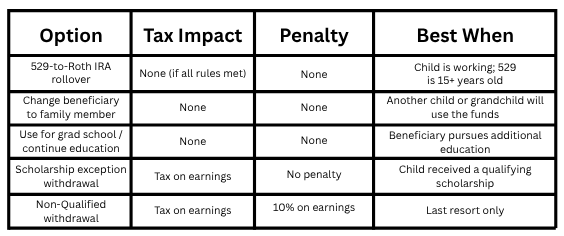
How It Compares to Other Options for Leftover 529 Funds